Abstract
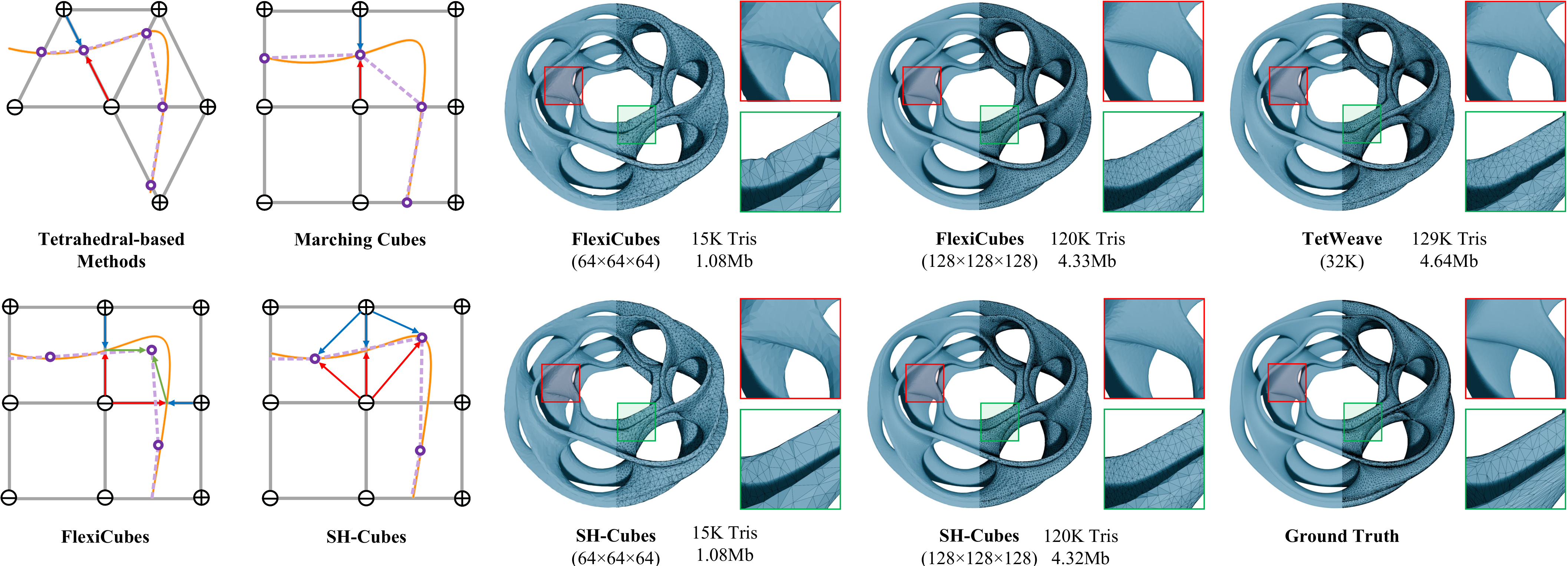
Differentiable surface extraction from implicit fields is a fundamental task in 3D reconstruction. However, accurately capturing sharp geometric features while maintaining topological integrity and high mesh quality remains a formidable challenge. Existing grid-based methods typically rely on isotropic implicit representations, which struggle to capture fine-grained sub-grid structures, forcing a compromise between over-smoothed features and mesh distortions caused by excessive vertex shifting. In this paper, we introduce SH-Cubes, a novel differentiable isosurface extraction framework driven by an Anisotropic Directional Field. By augmenting the Signed Distance Field (SDF) with Spherical Harmonics (SH), we enrich the implicit representation with direction-aware geometric priors to resolve complex intra-cell geometry. During the mesh extraction stage, to robustly determine dual vertex placements, we introduce a complexity-aware adaptive aggregation module that optimally integrates geometric cues across edges, faces, and cells. Driven by our feature-aware directional formulation, the mesh naturally aligns its topology with underlying geometric discontinuities. This allows for the high-fidelity reconstruction of intricate surface details while adhering to manifold constraints. Extensive evaluations demonstrate that SH-Cubes achieves state-of-the-art reconstruction quality on complex topologies, successfully reconciling the inherent trade-off between high-frequency geometric feature recovery and robust, artifact-free mesh extraction.
Continuous Anisotropic Field
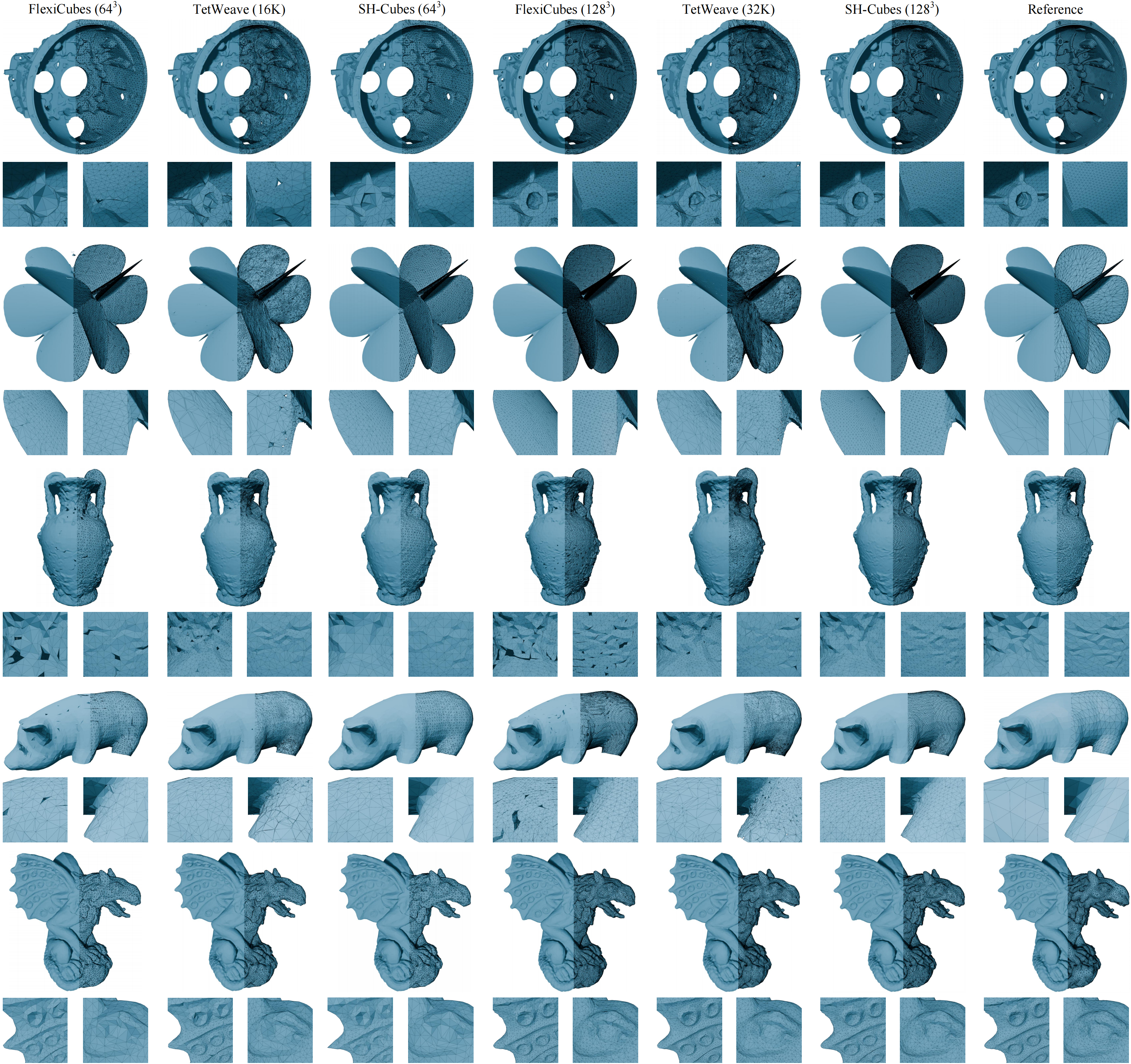
Visual Results
BibTeX
@misc{jin2026shcubes,
  title={SH-Cubes: Differentiable Isosurface Extraction from Continuous Anisotropic Fields via Spherical Guidance},
  author={Jin, Hairong},
  year={2026},
  url={https://hairong-jin.github.io/projects/SH-Cubes/}
}